

Individual Oyster Cracker Packets: Size, Calories & Ingredients
If you have ever tipped half a box of oyster crackers into a bowl and found the rest gone soft a week later, individually wrapped packets solve exactly that problem. This guide covers what is actually inside a single-serve oyster cracker packet — size, calories, ingredients, allergens and storage — using the label data from the Westminster Bakers oyster crackers we stock.
-
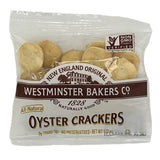 Westminster Bakers New England Oyster Crackers – 40 Individually Wrapped 0.5 oz Packets40 individual 0.5 oz packets · about 51¢ a packet
Do oyster crackers contain oysters?
No. It is a common question, and the ingredient list settles it. Westminster Bakers oyster crackers contain:
Unbleached wheat flour, water, canola oil, salt, cane sugar, baking soda, yeast.
There is no oyster, no shellfish and no seafood of any kind in them. The name comes from how they are eaten, not what they are made of — they were the traditional accompaniment to oyster stew and clam chowder in New England, and the name stuck.
How big is one individual oyster cracker packet?
Each packet holds 0.5 oz of crackers, and a box contains 40 packets.
| Measure | Amount |
|---|---|
| Packet size | 0.5 oz (about 14 g) |
| Packets per box | 40 |
| Total cracker weight | 20 oz (40 × 0.5 oz) |
The label counts one 0.5 oz packet as one serving, about right for one bowl of soup. At one packet a bowl, a box of 40 covers 40 bowls.
How many calories are in a packet of oyster crackers?
45 calories per packet. The Nutrition Facts on each Westminster Bakers packet give the serving size as 1 package, so every figure below is for one whole 0.5 oz packet:
| Nutrient (per packet) | Amount | % Daily Value |
|---|---|---|
| Calories | 45 | — |
| Total fat | 1 g | 1% |
| Trans fat | 0 g | — |
| Sodium | 80 mg | 3% |
| Total carbohydrates | 7 g | 3% |
| Protein | 1 g | — |
One packet is one serving. There is nothing to weigh or count out: open a packet and you are eating exactly what the label describes. These figures come from the packets we ship.
In plain terms, one packet adds 45 calories and 80 mg of sodium (3% of the daily value) to your bowl, so you know exactly what the crackers bring to the meal.
Allergens: these contain wheat
Oyster crackers are not gluten-free. The first ingredient is unbleached wheat flour, and the pack carries a "contains wheat" declaration.
This matters more than usual for anyone arriving here from a soup or broth search. Plenty of bouillon and stock products are labelled gluten-free — the Herb-Ox chicken bouillon cubes and Herb-Ox beef bouillon cubes we stock are two of them — so it is easy to assume the crackers alongside them are too. They are not. If you are cooking for someone with celiac disease or a wheat allergy, oyster crackers are not the cracker for that bowl.
The only allergen the packet declares is wheat. There is no shellfish in the ingredient list, despite the name.
What is printed on the packet
- All-Natural, printed on the front of the packet
- Non-GMO Project Verified seal
- No preservatives
- 0 g trans fat
- Kosher: the OU symbol is on the packet
- Seven ingredients in total, all of them ordinary pantry items
The short ingredient list is one practical reason the single-serve format works: with no preservatives in the recipe, the sealed wrapper is what keeps air and moisture away from each serving until you open it.
Why individual packets instead of a box?
The trade-off is straightforward.
What you gain
- They stay crisp. Every packet is sealed until the moment it is opened. Once a big box is opened, every cracker in it is exposed to air; with packets, only the one you open is.
- Portion control without measuring. One packet is one labeled serving: 45 calories. Useful if you are tracking intake and would rather not weigh crackers.
- They travel. A packet survives a lunchbox, a desk drawer, a glovebox or a hospital bag in a way that a handful from a box does not.
- Serving other people. If you are putting soup in front of guests, patients or customers, sealed packets are the hygienic option.
What you give up
- Packaging. Forty wrappers is forty wrappers. If crispness is not a problem in your house because a box disappears in two days, the bulk box is the lower-waste choice.
- Cost per ounce. Single-serve packaging costs more to produce than one large bag, and that shows up in the price of any single-serve format.
How to store oyster cracker packets
Keep unopened packets somewhere cool and dry — a cupboard away from the stove is ideal, since heat and steam are what turn crackers soft. Because each packet is individually sealed, you do not need an airtight container for the box itself.
Once a packet is open, treat it like any opened cracker: eat it that day, or fold it shut and accept some loss of crunch. Opened crackers pick up moisture from the air, which is what softens them. For the shelf life of the box itself, go by the best-by date printed on the packaging rather than a general rule of thumb.
What to eat them with
The classic pairings are the soupy ones — clam chowder, oyster stew, tomato soup, chili, and any broth-based bowl where you want something crunchy that will not overwhelm it. They are also good crushed over a salad in place of croutons, floated on French onion soup, or eaten straight from the packet.
If you are building the soup itself from a bouillon cube, two of our other guides cover that side of the bowl: bouillon cube conversions, calories and sodium, and what to know about MSG in bouillon cubes.
Frequently asked questions
Do oyster crackers have oysters in them?
No. The ingredients are unbleached wheat flour, water, canola oil, salt, cane sugar, baking soda and yeast. There is no shellfish in them. The name refers to being served with oyster stew and chowder.
How many individual packets come in a box?
Forty, with 0.5 oz of crackers in each packet.
Are oyster crackers gluten-free?
No. They are made with unbleached wheat flour and carry a "contains wheat" declaration.
Are oyster crackers vegan?
The packet does not say vegan or dairy-free, and it carries no vegan certification. Its full ingredient list is unbleached wheat flour, water, canola oil, salt, cane sugar, baking soda and yeast, and the only allergen it declares is wheat. Check that list against your own needs.
How many calories are in oyster crackers?
45 calories per 0.5 oz packet. The label's serving size is 1 package, so one packet is one serving: 45 calories, 1 g of fat, 80 mg of sodium, 7 g of carbohydrates and 1 g of protein.
Are these oyster crackers non-GMO?
Yes. The packet carries the Non-GMO Project Verified seal. It is also marked All-Natural, No Preservatives and 0 g trans fat, and it carries the OU kosher symbol.
How much sodium is in oyster crackers?
80 mg per packet (one serving), which is 3% of the daily value.
The short version
Individually wrapped oyster crackers are a seven-ingredient wheat cracker, 45 calories and 80 mg of sodium per packet, sold 40 packets to a box at 0.5 oz each. They contain no oysters and no gluten-free credentials — wheat flour is the first ingredient. The single-serve wrapper is doing real work in a recipe with no preservatives in it, which is the main reason to choose the format.
We stock them in the 40-count box: Westminster Bakers New England Oyster Crackers. Standard shipping is free on orders of $15 or more to all 50 states, and this box qualifies on its own. Orders placed before 3 PM ET, Monday to Saturday, ship the same day.